
Thousands of indigenous people march and point to Congress as an enemy of the people.
A solemn session was also held in the Chamber of Deputies in honor of the Free Land Camp (ATL).
AI generated audio
By Helena Corezomaé/OPAN
This Tuesday (7), thousands of indigenous people from all over Brazil participated in the march “Congress enemy of the peoples: our future is not for sale”, in Brasília. The group departed from the Ibero-American Cultural Axis, where the Free Land Camp (ATL) takes place, and headed towards the National Congress.
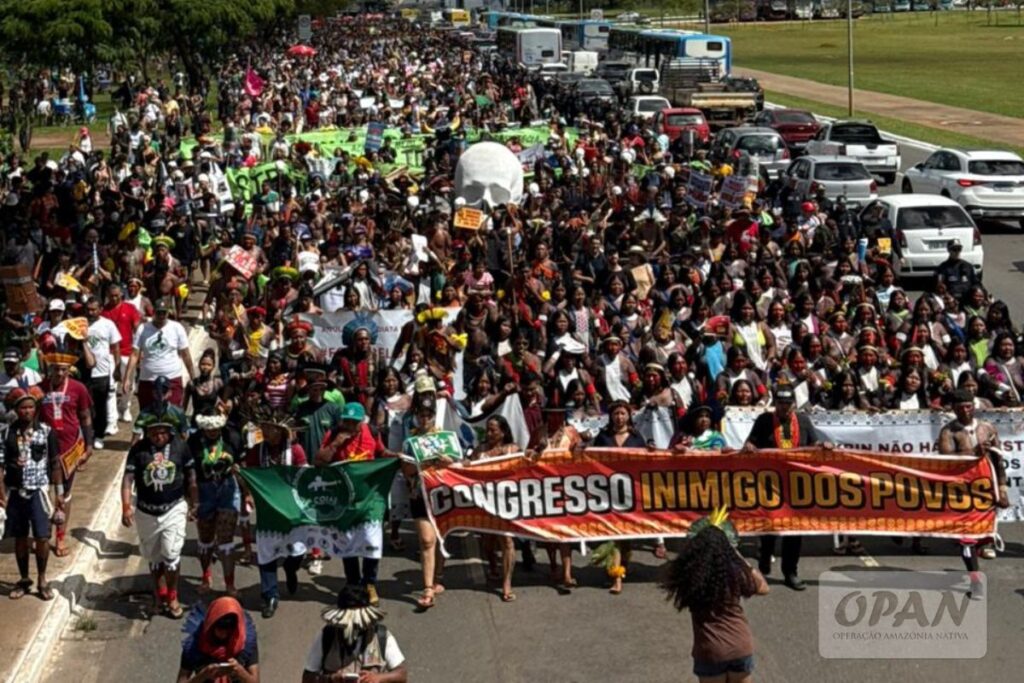
Toya Manchineri, general coordinator of the Coordination of Indigenous Organizations of the Brazilian Amazon (Coiab), emphasized that, although the demarcation of territories is the central demand of all ATLs (Acampamento Terra Livre – Free Land Encampments), this year’s march has a more incisive political focus: Congress as an obstacle to indigenous rights.
“In Congress, we have a large number of bills and amendments to the Constitution that violate the constitutional rights of indigenous peoples,” he emphasized.
Kleber Karipuna, executive coordinator of the Articulation of Indigenous Peoples of Brazil (APIB), reinforced the chorus against the Legislative branch, stating that the 22nd edition of the ATL seeks to send a clear message: “Indigenous peoples will continue to resist any proposal that threatens their historical achievements.”
This concern is materialized in projects such as Constitutional Amendment Proposal (PEC) No. 48/2023, which seeks to establish a time frame for the demarcation of lands traditionally occupied by indigenous peoples, establishing that these lands are those that were under indigenous possession on October 5, 1988, the date of the promulgation of the Constitution, even though the thesis has already been voted unconstitutional by the Supreme Federal Court (STF) in the judgment of Extraordinary Appeal (RE) 1,017,365, a case of general repercussion, and in the actions regarding Law 14,701/2023.
While the mobilization occupied the streets, the Chamber of Deputies held a solemn session in honor of the ATL, fulfilling a request from congresswoman Célia Xakriabá (PSOL-MG) and Pedro Uczai (PT-SC). The event also included the presence of federal congresswomen Sonia Guajajara (PSOL-SP) and Juliana Cardoso (PT-SP), highlighting the strength of the “headdress caucus” in parliament.
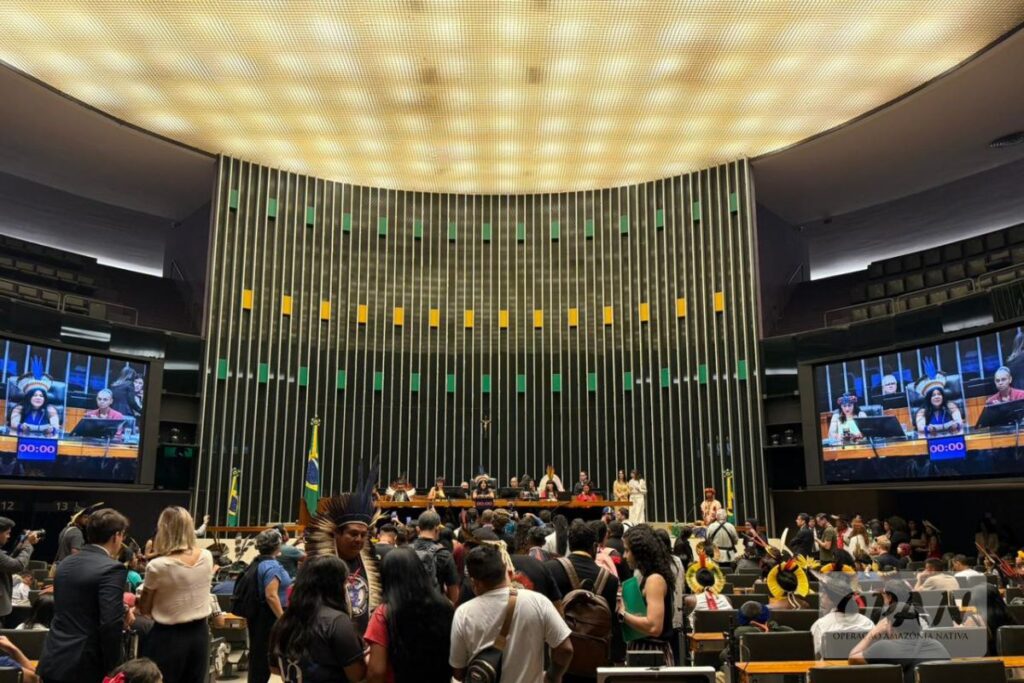
Sonia Guajajara celebrated the historic transformation of indigenous mobilization, highlighting the new political moment in which leaders occupy the center of decision-making. “Who would have thought that our trajectory of indigenous mobilization could be here today, with a table composed of authorities occupying strategic positions in the Executive Branch,” she pointed out, recalling that the time of invisibility is behind us.
For Sonia, the Free Land Camp transcends a simple demonstration, functioning as an urgent call to the State’s responsibility. She emphasized that the struggle is not only for the past, but for the survival of tomorrow: “The ATL is, above all, a call for the future. Because we, indigenous peoples, do not only speak of the past; we speak of the present and we build the future.”
The protection of territories was presented as fundamental to global climate balance. Sonia argued that ancestral wisdom is the key to sustainability. “A future that depends on balance with nature; and those who bring this balance between humanity and the environment are us, the indigenous peoples, as history has already proven,” she stated to applause.
In closing her speech, the former minister reaffirmed the movement’s determination to maintain the occupation of institutional and social spaces. With a tone of hope and resistance, she guaranteed the continuation of the struggle: “We will continue together occupying the streets, the territories, and also this parliament. There will never again be a Brazil without us, the indigenous peoples.”
Célia Xakriabá began her speech celebrating the expansion of indigenous representation in Congress, highlighting that the current occupation is the result of a collective effort. “We didn’t get here alone. From now on, we will have a more indigenous parliament, one that transcends the historical presence of Juruna Xavante and the trajectory of Joenia Wapichana,” stated the congresswoman.
The parliamentarian emphasized that the presence of the “headdress caucus” is an invitation for all Brazilian biomes to see themselves represented in national politics. She used a sports metaphor to illustrate the historical exclusion of her people: “In the history of Brazil, there has never been an opportunity for indigenous peoples to play the second half. That’s why we are here now to enter the field and decide the game,” referring to the historical difficulty indigenous representatives have faced in achieving re-election..
Finally, the congresswoman called on Congress to make a real commitment to the safety of leaders and the integrity of indigenous lands. “Those who must take action should do so for the demarcation of our territories, because we will no longer accept seeing our leaders murdered while fighting for their rights.”.