
Brazil: lessons from the water people
Faced with a dramatic decline in pirarucu, a fish that is essential to their survival, the Paumari people of Amazonas state took part in a programme to restore the species, combining scientific and traditional knowledge. After a few years, the fish are once again populating the Purus River.
By Marcelo Silva de Sousa, Journalist for The UNESCO Courier
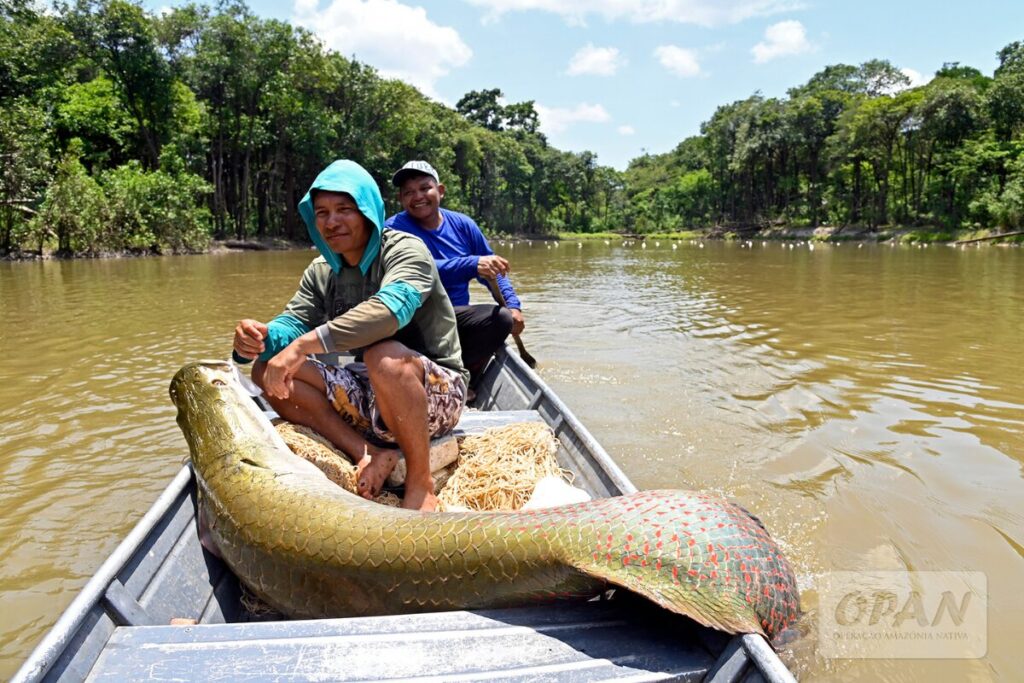
On the Purus River, as the light fades and the heat lingers over the water, a pirarucu fish comes to the surface to gulp some air. This sound – deep, damp, ancestral – revives a pulse that this land had almost lost. “Nature was begging for our help,” recalls Chico Paumari, a young fisherman. “We would arrive at the lake to find there was nothing left. It was heartbreaking to see our food supply exhausted. We didn’t know how to feed our children.”
© Adriano Gambarini / OPAN
Dawn gives off an odour of ferrous humidity mingled with brazier smoke. The Paumari, an Indigenous people of about two thousand souls living in the vast region of Amazonas state in the north-west of the country, have a way of defining themselves that can’t be found in any scientific textbook: “We are the people of the water, the only ones who truly live within it.” When the population of pirarucus, the world’s largest freshwater fish, fell to just 266 adult specimens in 2009, the Paumari faced an existential threat.
For years, academic research and traditional knowledge evolved in parallel without ever meeting. Technicians arrived with their forms. Indigenous communities offered their intuition. The turning point came when they both decided to “share the same canoe”, an alliance fostered by OPAN (Operação Amazônia Nativa), one of Brazil’s oldest Indigenous organizations, which, on this occasion, acted as a bridge between these two worlds.
A bridge between two worlds
The recovery of the pirarucu, whose population now numbers more than 10,000 adult individuals, was made possible by a community management method that combines territorial surveillance, annual censuses and controlled harvesting that never exceeds 30 per cent of adult fish. This is neither purely science nor purely tradition, but a form of social technology that draws its core components from both worlds: from biology, protocols and monitoring; from ancestral knowledge, the ability to read the water, life cycles and respect for the limits imposed by nature.
“They know how the river flows, where the fish take refuge, how they react to the moon or the mud,” explains Felipe Rossoni, a biologist at OPAN who has been working with the community since 2009. “Our role has been to help organize this knowledge without altering its essence so that we can engage with State regulations.”
According to Rossoni, this joint management has made it possible to achieve much more than simply restoring a fishery resource – it has united the community around a common agenda, strengthened local governance, enabled the building of infrastructure and the creation of a community fund, while restoring a sense of pride in those who had felt rejected for generations.
“Today, when we see that the lake is full of fish again, we know that it has come back because we have protected it,” says Chico Paumari. “We never want to be a forgotten people again.”
Influencing decisions
This local success is part of a broader process in Brazil – the gradual incorporation of Indigenous knowledge into national decision making. At the heart of this movement is Eloy Terena, an Indigenous lawyer and executive secretary of the Ministry of Indigenous Peoples, created in 2023, who recognizes that this approach presupposes education. “The challenge is both technical and legal – we have to succeed in integrating village knowledge and the rhythms of nature into the functioning of the administration,” he explains.
“It is a matter of translating the traditional worldview into procedures that can influence climate policies”
Put simply, it is a matter of translating the traditional worldview into procedures that can influence environmental permits, boundaries and climate policies. This approach still meets with some resistance. Some economic sectors continue to perceive land demarcation as an obstacle to development.
However, studies show the relevance of Indigenous practices in the management of their lands. According to IPAM, the Amazon Environmental Research Institute, these Indigenous lands are “far better” equipped to contain deforestation.
“The figures speak for themselves,” says Paula Guarido, a researcher at IPAM. “Over the last 30 years, Indigenous lands in Brazil have lost only 1.2 per cent of their original vegetation. Private lands, over the same period, have lost nearly 20 per cent.”
The climate data are even more revealing. In the Xingu Indigenous territory, located in the Brazilian states of Mato Grosso and Pará, the average temperature is two degrees lower than in the surrounding agricultural areas, and evapotranspiration – the driving force behind the “flying rivers” that irrigate the south-central part of the continent – is significantly higher. “Where there is Indigenous land, there is standing forest,” sums up Paula Guarido. “They represent the last green frontier.”
During the climate conference (COP30) held in November 2025 in Belém, Brazil, the voice of Indigenous Peoples became established as a necessary pillar of any serious climate strategy.
Flying rivers
There is a direct link between the restored lakes of the Purus, satellite images of the Xingu and global climate commitments. A link that, according to experts, indicates that the defence of Indigenous territories is inseparable from global climate stability.
At dusk, when the sounds of the rainforest change frequency, the Amazon continues to send moisture, in the form of flying rivers, towards the south of the continent, irrigating crops whose beneficiaries often ignore – or underestimate – the role of those who perpetuate this cycle.
“Protecting Indigenous territories is not an act of anthropological charity; it is a strategy for planetary survival”
The lesson from the water peoples is simple and urgent – protecting Indigenous territories is not an act of anthropological charity; it is a strategy for planetary survival.
Dinamam Tuxá, coordinator of APIB (Articulation of Indigenous Peoples of Brazil), delivers a message that sums up the spirit of this story: “We have the technology to prevent the end of the world. The question is whether humanity is ready to learn, or whether it will continue to believe that it knows better than the Earth,” he concludes.
Originally published in “The UNESCO Courier” on January 16, 2026. Available at: https://courier.unesco.org/en/articles/brazil-lessons-water-people