
“We feel violated,” says the lead after a meeting of the conciliation board of the SUPREME court, to discuss the framework of a temporal
As if that wasn’t enough to reconcile the rights are immutable, the indigenous people have experienced tutelage, and with the declaration of the judge who conducted the meeting.
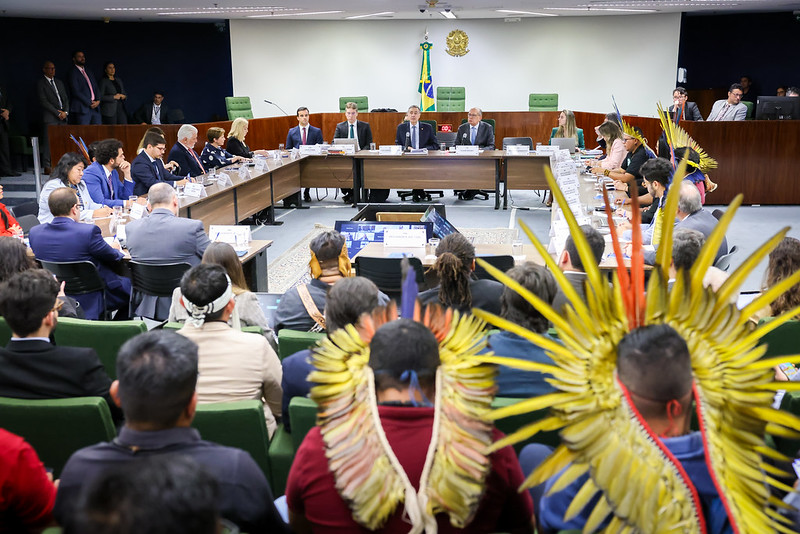
A resolution meeting was held in the Supreme Court (SUPREME court on Monday to (5) of the Law 14.701/2023, the landmark in time, he was selected for the violation of the rights of indigenous peoples.
The same being contrary to the meeting for consensus-building, because of the rights of indigenous peoples, who are of fundamental rights and, therefore, are non-negotiable, and the organizers have made it a point to have a presence, but it does not have all the lines met, as explained by the legal advisor to the Coordination of the Indigenous Organizations of the Brazilian Amazon (Coiab), and the co-Ordination of Organisations, and Joints in the indian state of Maranhão (Coapima), Kari Guajajara.
“No-one listens to what the indigenous people are talking about. We want a dialogue. For a long time, we teach you how to do the dialogue, and to be sitting at this table, it is an expression of that provision, even in those of our loved ones being attacked, most of the people are already saying, ‘we don’t want to reconciliation’. We open our hearts, we’re here for. We’ve got it all to lose it. And that’s why we’re here,” said Kari.
Here’s what’s on the act 14.701 in the SUPREME court:
The Direct action of Unconstitutionality (ADI) 7582, in favour of the rights of indigenous
Authorship: the Articulation of the Indigenous Peoples of Brazil (Apib), and the Party of Socialism and Liberty (PSOL)
is Available here!
The Direct action of Unconstitutionality (ADI) 7583, in favour of the rights of indigenous
Authorship: the Workers ‘ Party, the Communist Party of Brazil (PCdoB), and the Green Party (PV)
Available to bei!
The Direct action of Unconstitutionality (ADI) 7586, in favour of the rights of indigenous peoples
by him: the Democratic Party of Labor (POLITICS)
– Available here!
Declaratory action of Constitutionality (ADC), 87, violation of the rights of indigenous peoples
, the Authors parties, the Liberal Progressives and Republicans are
Available right here!
The Direct action of Unconstitutionality by Omission (ADO) x86, violation of the rights of indigenous
Authorship: the Progressive Party
, Available here!
I Karipuna, the co-ordination of Coiab), and the Articulation of the Indigenous Peoples of Brazil (APIB), it is also reported that the voices of the leaders, they were not listened to at various times. A request is made for the APIB for more time to come forward with a statement on the continuation of the negotiations, it had been entirely overlooked, and is only observed after the speech of a non-indigenous peoples in canada.
“Even the people making this claim, it was only accepted after the proof of the manifestation of the Ministry of Indigenous Peoples. We are also very much to have been infringed, including the supervision of the State. The judge, who was leading the reconciliation [Diego Viegas Veras] , said that the Funai, [Fundação Nacional dos Povos Indígenas] he would be able to pick for the position of the indigenous movement,” said I Karipuna, at a press conference after the meeting.
The leader of the Karipuna remembered as the review of the court of Diego Viegas take a look at the reference to the process of supervision, it is done in Brazil, after the Federal Constitution of 1988. “It shows how prejudice and institutional racism are rooted in the realms of power.”
Even that is led by indigenous women, Funai, and the Ministry of Indigenous Peoples ‘ have as their duty the protection of the rights of indigenous peoples, which includes respect for the self-determination of all peoples. None of the bodies to replace the organizations and movements of the indigenous people.
A delegation of the 42-team of Thick Bush has been up to Brasilia to attend the meeting, and to show, against the decision of the framework in time and the other backs on the law, 14.701. The lawyer and the executive director of the Xingu Indigenous Land Association (ATIX), Ewésh Yawalapiti Waura, it was in the group, he told them that, initially, they were barred from entering the premises.
“In the first place, at the entrance, we have been barred for safety and security. Then you have to see: a situation of discrimination against women. After that, we went in, there was this moment, where the court said that the Funai was a gift and I was going to represent the indigenous peoples of the Funai is not a guardianship over the indigenous peoples. The APIB I was there and it was the APIB, which came with a direct action challenging the law. The SUPREME court came up with the chamber of conciliation, in fact, to try to negotiate for the rights of indigenous peoples,” he said Ewésh.
A meeting of the conciliation board
The committee of conciliation proposed by the prime minister Gilmar Mendes, a rapporteur for the actions of reasons pro and contra of the rights of indigenous peoples, with the four-question of the validity of the law, and asks the SUPREME court to declare it constitutional. The audience for this show was the first in a series of meetings that go on until the 18th of December of the same year, with the forecast for the next meeting, on 28 August, and in September, the court on the 9th and the 23rd, depending on the expression of the APIB, which is requested within 48 hours to discuss all of the meetings with the leaders of the indigenous population.
The decision, which established the commission, the prime minister Gilmar Mendes, has argued that the debates about the milestone, in a temporal, should focus on the resolution of the “problem ‘ with the participants of saints are content to this call, and to avoid the exhibition too long, and the discussions failed without any other solutions, feasible to be implemented.”
For the indigenous peoples, however, there is nothing to negotiate with and without a suspension of the law, 14.701, and that it’s unconstitutional, and it is already causing uncertainty and the rise of violence in our communities.